 Capture · Record · Stream · Encode · DecodeCapture · Record · Stream · Encode · Decode
Hardware encoders stay in service because they do one job predictably and can gain new protocols through firmware, so a unit bought for one workflow can be put to another later. That matters in a broadcast sector that has always been cyclical. Business models shift, standards evolve and budgets tighten, and attention tends to go to whatever is new. Meanwhile some of the most dependable building blocks have changed quietly in the background, adapting without needing to be replaced.
Hardware encoders are one of those building blocks. Software-based encoding attracts the headlines, but dedicated encoding hardware still sits under many live production, contribution and distribution workflows across Europe. Its appeal is predictability: an encoder that does nothing else behaves the same way every time it is switched on, with no desktop operating system or other applications competing for the processor. Increasingly, these devices pair that consistency with firmware development, which lengthens their useful life and protects the money spent on them.
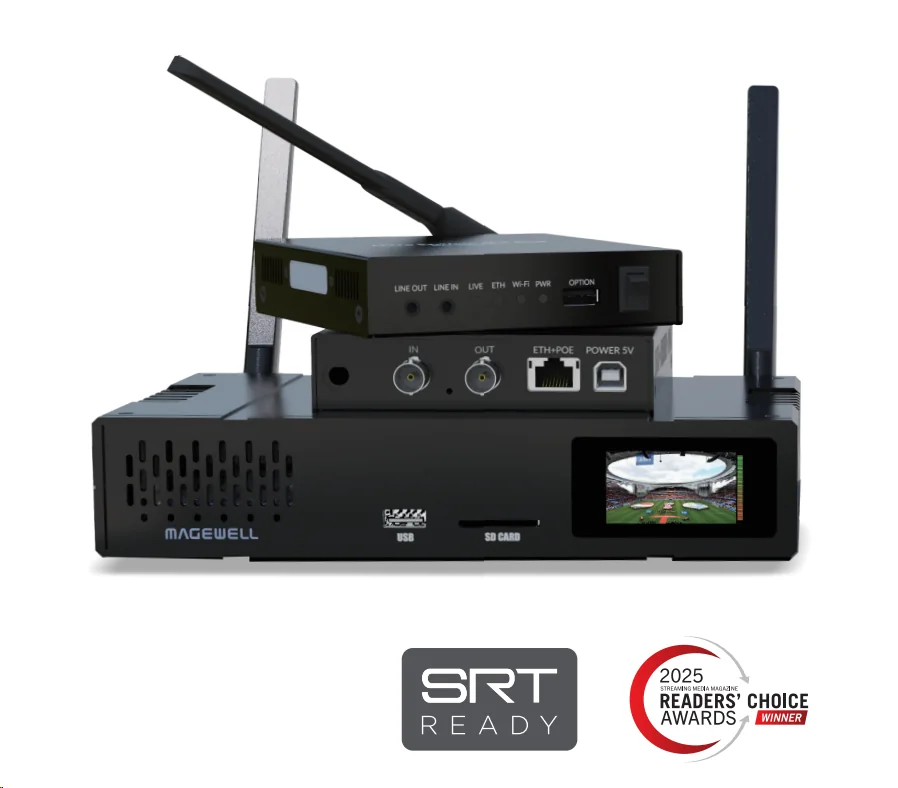
Magewell's Ultra Encode range is a useful example. It was not built around a single application; firmware updates have widened the set of broadcast and ProAV jobs it can do. The range runs from the Ultra Encode HDMI and Ultra Encode SDI, which encode up to 1080p60, to the Ultra Encode HDMI Plus, Ultra Encode SDI Plus and Ultra Encode AIO, which add recording and more protocols. They are used for live streaming, remote contribution and IP-based production, particularly where system integrators want something simple to deploy and to maintain over the long term.
Flexibility has been part of the design from the start. Ultra Encode devices are firmware-upgradable, so new protocols and workflows can be introduced over time. Every model streams RTMP, RTMPS, RTSP, SRT, HLS, MPEG-TS, NDI HX and TVU's ISSP, and the Plus and AIO models add NDI HX3, Zixi and RIST. One encoder can therefore feed a public streaming platform, a contribution link to another site and the local NDI network. That fits European broadcast environments, where hybrid infrastructure and equipment from several vendors are the norm.
Through 2026, development of hardware encoders is being shaped by interoperability and choice. RIST is a good example: it is an open standard for reliable contribution over unmanaged networks such as the internet, and the Ultra Encode Plus and AIO models now support it as both Caller and Listener alongside SRT. Device management is moving the same way. Ultra Encode units are configured from a Web UI, can be managed together through Magewell Control Hub and, on most models, provide APIs for third-party control systems, so broadcasters and integrators can monitor and control them without tying a workflow to one ecosystem.
For a broadcaster or integrator the practical point is this: a dedicated encoder bought today can gain new capabilities through firmware updates, while keeping the stability that made hardware encoding a trusted part of broadcast infrastructure. If you would like help choosing between the Ultra Encode models, talk to us.
ForeFront Imaging is the authorised UK distributor for Magewell. We stock the full range and can help you choose the right encoder for the job.
Browse Products Talk to UsNo marketing noise. Just new product launches, firmware updates, and the occasional guide.
No spam. Unsubscribe any time. Your email is never shared.
Enjoying your visit? Quick rating of your browsing experience so far:
Anything specific? (optional)
