Magewell Director One
Go live from anywhere with a 4G signal: switch, stream and record on a 7-inch touchscreen with built-in 4G.
- ✓7-inch AMOLED touchscreen (1920×1080, 800 nit) helps keep your preview readable outdoors
- ✓2 HDMI 2.0 inputs (up to 4096×2160 at 60 fps), USB camera inputs and up to three live IP sources (SRT, RTMP, RTSP, NDI)
- ✓Produces and streams at up to 1080p60 in H.264 or H.265, to four destinations at once
- ✓Records to 64 GB of internal storage or an SD card, with two-source ISO recording so you can re-edit afterwards
- ✓Built-in 4G modem, Gigabit Ethernet and Wi-Fi, with network bonding, so you can stream without venue internet
- ✓HDMI output (1080p) for an external screen, and USB-C output (display or UVC)
- ✓Runs from the 12 V adapter or two hot-swappable NP-F batteries (add your own)
About this product
Some of the most worthwhile streams happen where there is no venue internet and no desk for a laptop: a touchline, a showground, a village hall. The Director One is made for those jobs. It is a portable live production switcher and hardware streaming encoder in one box, with a built-in 4G modem. It takes in cameras and other sources, lets you switch between them on its own touchscreen, adds graphics, and streams and records the result. Switching, graphics, streaming, recording and monitoring all live in one device, so you can leave the computer behind.
A screen for outdoor work
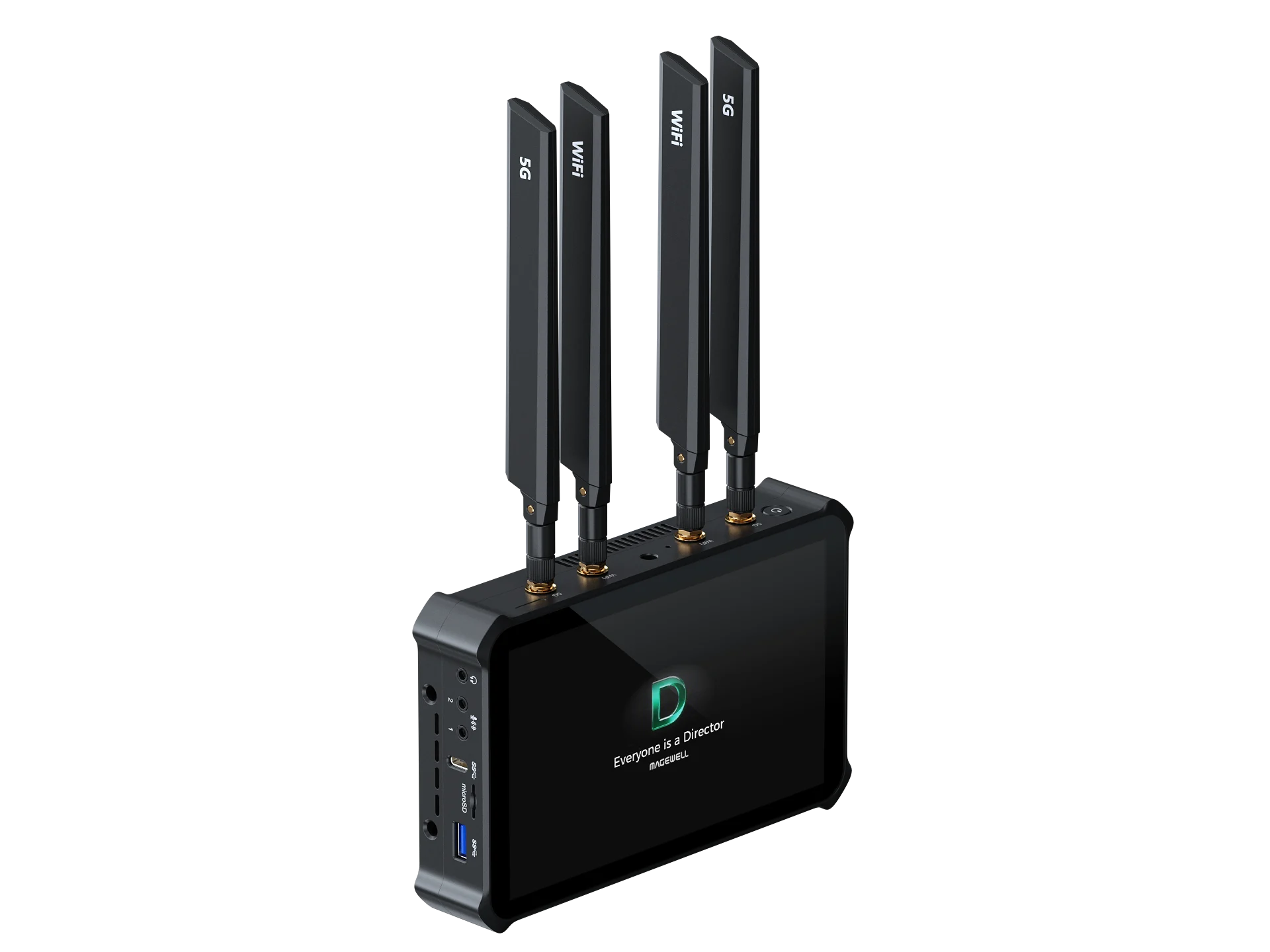
It has a 7-inch AMOLED capacitive touchscreen with 1920×1080 resolution and 800 nit brightness. You run the whole production by touch. At 800 nit it is the brighter of the two 1080p Director models, and a sun hood is included for outdoor use, which helps keep your preview readable in daylight.
What goes in
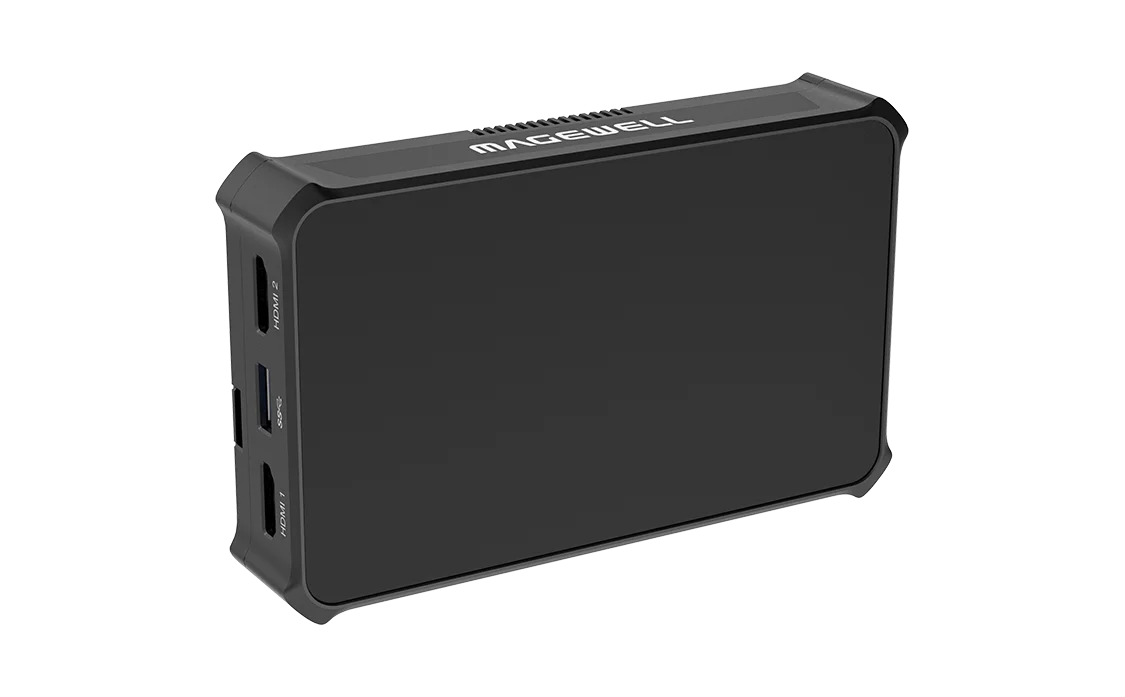
- HDMI. Two HDMI 2.0 inputs, each accepting up to 4096×2160 at 60 frames per second. The production itself is 1080p, so 4K sources are scaled to fit and you can use a 4K camera as it is.
- USB. Two USB 3.0 Type-A ports and one USB 3.0 Type-C port, giving two USB audio/video inputs for webcams and similar devices at up to 1080p60.
- IP sources. Up to three live network sources at once, from SRT, RTMP, RTSP and NDI (High Bandwidth, HX2 or HX3), so a remote camera or guest feed can join the show.
- Phones and files. A phone can be used as a camera through the Director Utility App. Video files, pictures and web pages can also be used as sources, which lets you play in a title sequence or sponsor slide.
- Audio. HDMI and USB audio, a 3.5 mm input, and Bluetooth audio.
What comes out
- Streaming. H.264 or H.265 at up to 1080p60, to four destinations at once: YouTube, Twitch and Facebook Live, plus SRT, RTMP, RTMPS and RTSP. Your audience can watch where they already are. It can also output NDI HX3. The maximum bitrate is 30 Mbps, or 62 Mbps for NDI HX3.
- Recording. MP4 or MOV, to the 64 GB of internal storage or your own SD card. ISO recording saves two different video sources at the same time, so you can re-edit afterwards.
- Monitor or computer output. One HDMI output at 1920×1080 connects an external screen. One USB-C output works either as a display output or as a webcam-style UVC output to a computer.
Production tools built in
You get scene switching with transition effects (fade, dip and DVE), chroma key, cropping, multiple graphics layers, a scoreboard and timer, replay, PTZ camera control and NDI tally lights. One operator can cut cameras, move a PTZ camera and update the score from the same screen.
Why choose it for location work
- Network. Gigabit Ethernet, Wi-Fi (2.4 GHz and 5 GHz) and a built-in 4G modem with a Nano SIM slot for your own SIM, so you can go live from places with no fixed line. Network bonding combines connections for a steadier stream.
- Power. The supplied 12 V adapter, or two NP-F batteries, which can be swapped one at a time while it runs. Add your own batteries. Power consumption is approx. 6 W idle and 27 W at full load.
- Size. 185.2 × 117.2 × 35.5 mm, approx. 709 g without antennas, so it travels in the camera bag.
Setting it up and controlling it
Besides the touchscreen, it can be controlled from the Director Utility App (iOS 13 or later, Android 7.0 or later), a Web UI in a browser, an Elgato Stream Deck using Magewell’s plugin, OSC, or Magewell’s APIs. It can be registered with Magewell Control Hub, which suits a team that looks after several units.
Where it sits in the range
The Director Mini is the smaller model, with the same two HDMI inputs and 1080p production, a 5.44-inch screen and a USB-C output. The Director Plus is the 4K model with four HDMI inputs, 5G and four-channel ISO recording. All three are on the Director range page.