Streaming Options to Keep Your Worship Community Engaged
Why Hardware Encoders Suit Worship Settings
Houses of worship typically need reliability over flexibility. A standalone encoder like the Ultra Stream HDMI or Ultra Encode HDMI runs without a PC, boots in seconds, and streams the moment power is applied. Volunteers do not need to manage software updates or driver issues before each service.
One-Camera Setup
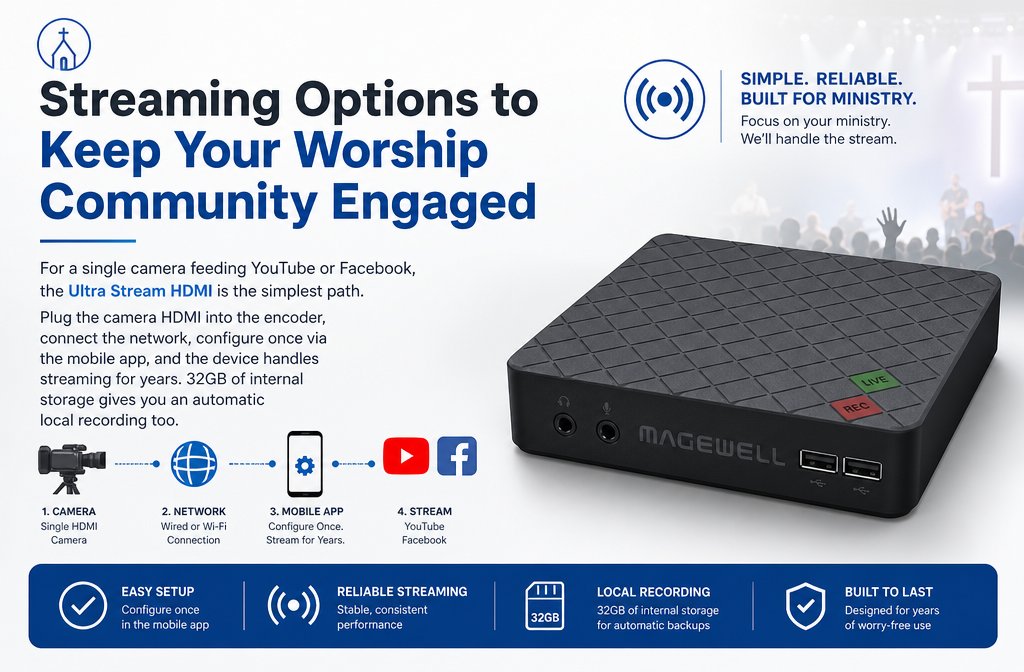
For a single camera feeding YouTube or Facebook, the Ultra Stream HDMI is the simplest path. Plug the camera HDMI into the encoder, connect the network, configure once via the mobile app, and the device handles streaming for years. 32GB of internal storage gives you an automatic local recording too.
SDI Camera Installations
Many established worship venues already have SDI cabling installed — fixed cameras on balconies, rear walls, or in the roof space where running new HDMI would be impractical. The Ultra Stream SDI takes a 3G-SDI feed directly and handles everything the HDMI version does: YouTube, Facebook, RTMP, and local recording. If your camera outputs both, SDI is generally the more reliable signal over longer cable runs. The Ultra Encode SDI adds multi-destination streaming if you need to push simultaneously to your own website, a CDN, and YouTube at the same time.
Multi-Camera Production
For switching between cameras, two paths exist. The Director Mini combines switcher and encoder in one box — HDMI, USB and NDI inputs, AMOLED touchscreen, and direct streaming with no PC. The alternative is a software switcher (vMix, OBS) fed by USB Capture or Pro Convert encoders. For most worship teams the Director Mini is the right choice: it removes the dependency on a laptop or desktop that could lock up mid-service.
Audio Considerations
Audio matters more than video for streaming services. Take your audio feed from the sound desk via an audio embedder into the HDMI signal, or use a device with dedicated audio inputs like the Ultra Encode HDMI Plus which has XLR line in/out for direct connection to professional audio infrastructure. Getting a clean, balanced feed from the desk rather than relying on camera microphones makes a significant difference to how the stream is received by your remote congregation.
Network Requirements
Streaming 1080p at 4–6 Mbps needs around 8 Mbps of stable upload. Test the network at the camera location, not just the office router. Ethernet is far more reliable than Wi-Fi for live streaming — if the camera position has no Ethernet drop, that should be the first investment before any encoder. If Ethernet genuinely is not possible, the Ultra Stream HDMI supports Wi-Fi and can also tether to a 4G mobile hotspot as a fallback.
Archiving and On-Demand Viewing
Most encoders in the Magewell range record locally to a USB drive or SD card simultaneously with streaming. This means every service is automatically archived without any additional equipment or software. The recording can be uploaded to YouTube as a replay after the service, or kept on a local NAS for the congregation to access. The Ultra Stream HDMI's 32GB internal storage holds several hours of 1080p footage before any external drive is needed.