 Capture · Record · Stream · Encode · DecodeCapture · Record · Stream · Encode · Decode
Hardware is faster. In a test run by Magewell in March 2020, a hardware NDI encoder feeding a hardware decoder averaged 46.6 ms from source to screen. Software encoding and decoding on a PC averaged 119.7 ms on the same network.
When you send video over a network, delay is often the thing you care about most. It decides whether a presenter stays in step with the big screen and whether an operator can cut cameras from what they see. This article sets out how the test was done, the figures it produced and what they mean when you choose equipment.
The same source, network and monitors were used throughout. Only the encoder and decoder changed.
2.1 Software encoder generating the NDI stream
The equipment was set up as follows:
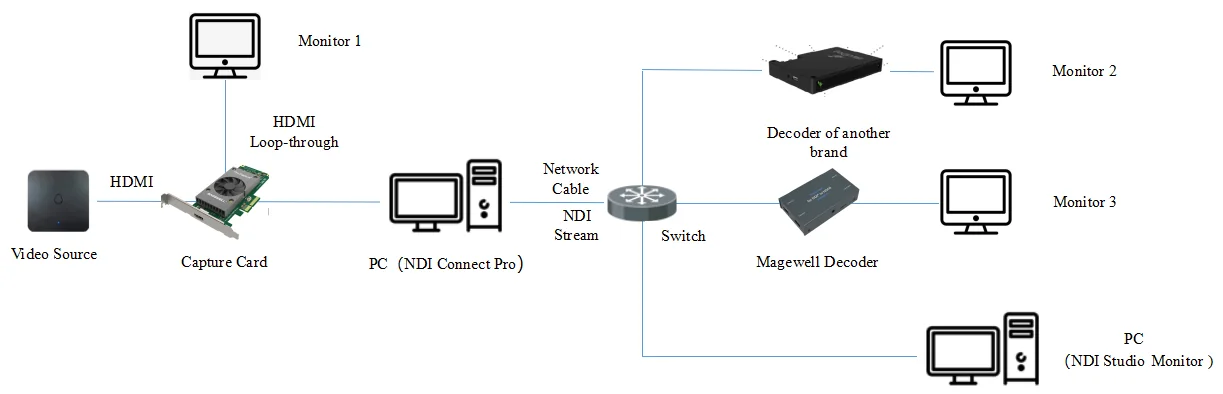
The Magewell capture card brought the video source into the PC, and NDI Connect Pro encoded it and sent it to the local network as an NDI® stream. At the same time, an unprocessed feed of the source went straight to Monitor 1. Nothing encodes or decodes that feed, so Monitor 1 stands for the source itself. Every decoded picture is compared against it.
Three decoders were connected to the same network: the Magewell Pro Convert for NDI® to HDMI (the "Magewell decoder" below), the decoder of another brand, and NDI Studio Monitor software. The two hardware decoders fed Monitor 2 and Monitor 3 over HDMI. NDI Studio Monitor displayed its picture on the PC.
The source was a specially made video of a running stopwatch. Comparing the time shown on Monitor 1 with the time shown by each decoder at the same instant gives the delay from encoding to the end of decoding. That difference is the transmission latency.
2.2 Standalone hardware encoder generating the NDI stream
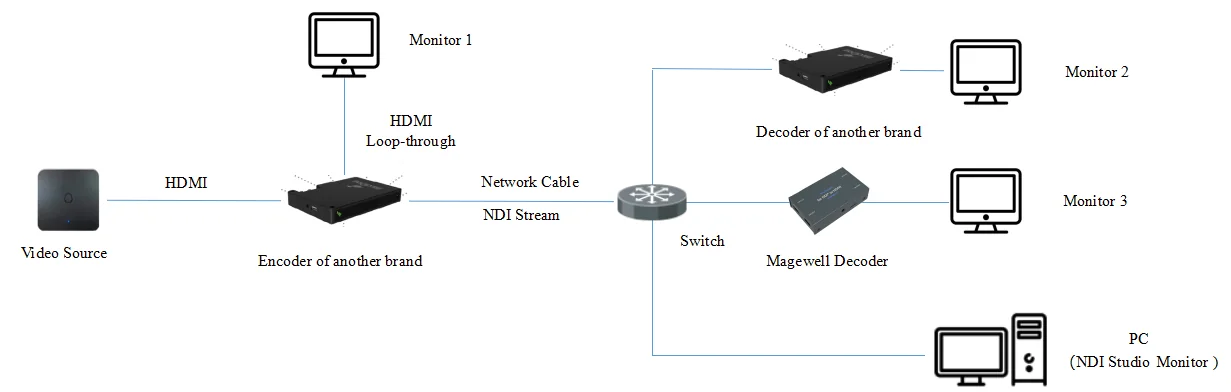
The encoding software was then replaced, first by the Magewell Pro Convert HDMI 4K Plus (the "Magewell encoder" below) and then by the encoder of another brand. Nothing else was changed. The equipment was set up as follows:
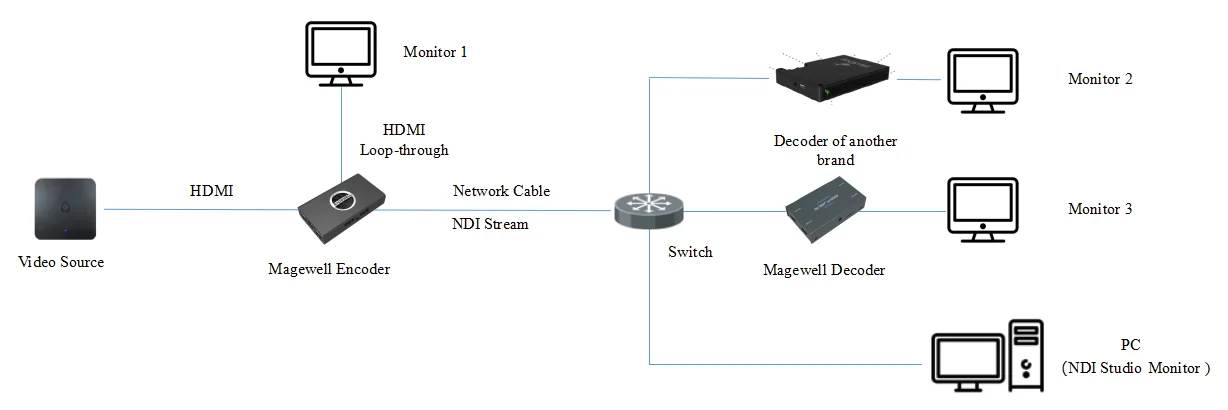
3.1 Software encoding. Average delay was 61.4 ms into the Magewell decoder, 66.3 ms into the other-brand decoder and 119.7 ms into the decoding software.
3.2 Magewell hardware encoding. Average delay was 46.6 ms into the Magewell decoder, 57.6 ms into the other-brand decoder and 99.6 ms into the decoding software.
3.3 Other-brand hardware encoding. Average delay was 55 ms into the Magewell decoder, 60 ms into the other-brand decoder and 121.7 ms into the decoding software.
The table below brings the averages together:
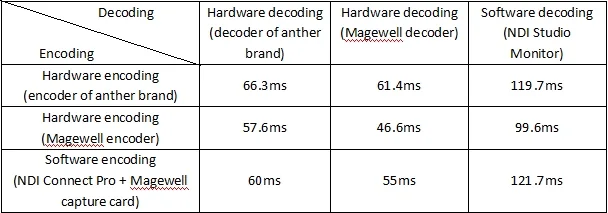
On the same network, the delay depends heavily on whether encoding and decoding are done in hardware or software. In this test the decoder made the bigger difference: whichever encoder was used, the decoding software was roughly twice as slow as either hardware decoder. A standalone encoder or decoder has dedicated resources for one job, and is not held up by the operating system or by other programs competing for the CPU.
If low delay matters to you, use hardware at both ends. The lowest figure in the test, 46.6 ms, came from pairing the Magewell encoder with the Magewell decoder. These figures come from one set-up, with 1080p60 video and the firmware listed above, so treat them as a comparison and not as a promise for your own network.
The buffer duration setting on a Magewell NDI decoder also affects delay. You can change it in the decoder’s Web UI. Magewell’s article "Test of Buffer Duration Value’s Effect on Pro Convert Latency" covers this in detail.
ForeFront Imaging is the authorised UK distributor for Magewell. We stock the full range and can help you choose the right encoder and decoder for your project.
Browse Products Talk to UsNo marketing noise. Just new product launches, firmware updates, and the occasional guide.
No spam. Unsubscribe any time. Your email is never shared.
Enjoying your visit? Quick rating of your browsing experience so far:
Anything specific? (optional)
