Authorised UK Magewell Distributor
🎓 Education  |  📡 Broadcast  |  🏥 Healthcare  |  ⛪ Houses of Worship  |  🏛️ Government
In Stock  ·  Same-day despatch  ·  UK-based support
ResourcesSoftwareBlog & ArticlesCase StudiesKnowledge BaseLiterature✍️ Submit a Case Study
← Back to Knowledge Base
🚀 Getting Started

HDMI vs SDI: Which Capture Interface Is Right for Your Workflow?
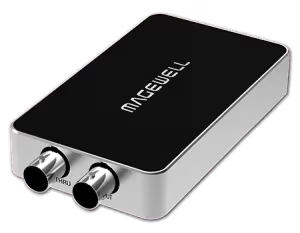
Magewell HDMI vs SDI: Which Capture Interface Is Right for Your Workflow? — sdi plus

HDMI: Consumer to Prosumer

HDMI was designed for consumer electronics. It carries video, audio, and control data over a single cable. Maximum reliable cable length is around 5-10 metres with standard cables. The connector is not designed for repeated connection in professional environments.

HDMI is used almost universally in cameras from consumer DSLRs to prosumer video cameras, game consoles, computers, AV equipment, and mixing systems.

SDI: Broadcast Professional

SDI was designed for broadcast. BNC connectors lock securely. Standard cables run reliably to 100 metres. The signal is uncompressed and error-correctable. SDI equipment is built for 24/7 operation in demanding environments.

SDI is found on professional broadcast cameras, routing switchers, broadcast monitors, and production infrastructure.

Cable Distance: The Practical Difference

This is the most practically significant difference for most installations. HDMI beyond 10 metres requires active or fibre-optic cables. SDI runs 100+ metres on standard 75-ohm coaxial cable. For any installation where the camera is more than 5 metres from the capture PC, SDI is strongly preferred.

Magewell Capture Choice

HDMI sources: USB Capture HDMI range or Pro Capture HDMI range.

SDI sources: USB Capture SDI range or Pro Capture SDI range.

Both types: USB Capture AIO (USB, 1080p) or Pro Capture AIO (PCIe).

Still need help?
Our UK-based technical team are available Monday to Friday 9am–5pm.
Contact Support+44 (0)116 277 5730

Related Guides

Stay Updated

New products and Magewell updates

No marketing noise. Just new product launches, firmware updates, and the occasional guide.

No spam. Unsubscribe any time. Your email is never shared.

Frequently Asked Questions

Use SDI when you need cable runs longer than 5–10 metres, when you're in a professional broadcast environment where SDI is the standard, or when you need a more robust locking connector. HDMI is simpler and more common for consumer and prosumer equipment.

Yes — modern HDMI 2.0 and 12G-SDI can both carry 4K video. The quality difference is negligible; the choice is about the connector type, cable distance, and compatibility with your equipment.

Yes. Magewell offers HDMI, SDI and AIO (all-in-one) variants across the USB Capture, Pro Capture and Pro Convert ranges. AIO models accept both HDMI and SDI inputs simultaneously.

Neither is universally better. HDMI is standard for consumer and prosumer equipment. SDI is the broadcast standard for professional cameras and production infrastructure. Choose the interface that matches your source equipment.

Standard HDMI cables are reliable to 5–10m for 4K, 10–15m for 1080p. SDI on standard coaxial cable is reliable to 100m at HD and up to 300m at SD. For runs over 10m, SDI is almost always the better choice.

Yes. Magewell Pro Convert range enables HDMI to NDI encoding and NDI to SDI decoding — converting HDMI to SDI across any network distance. Direct HDMI-to-SDI converters are also available from other manufacturers for simple one-hop conversions.

3G-SDI supports up to 1080p60. 6G-SDI supports 4K30. 12G-SDI supports 4K60. Magewell offers Pro Capture and Eco Capture cards supporting 12G-SDI, as well as the Pro Convert 12G SDI 4K Plus encoder.