NDI (Network Device Interface) is a protocol that allows video, audio, and data to be transmitted over standard Gigabit Ethernet in real time. Sources are automatically discovered by receivers on the same network — no IP address configuration required.
Traditional video requires dedicated cables per source. NDI runs over existing network infrastructure. A camera with an NDI encoder at its position feeds all production systems on the network simultaneously, without additional cable runs.
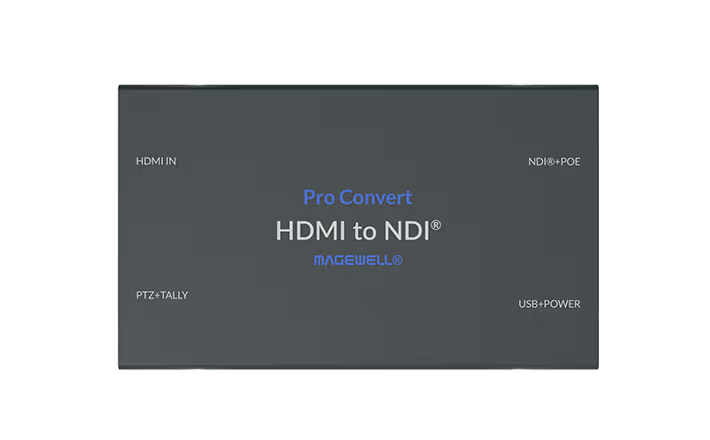
The simplest NDI setup: one Pro Convert HDMI TX at a camera position, one computer running vMix or OBS with the NDI plugin on the same network. The TX encodes the camera HDMI output to NDI. vMix auto-discovers it and adds it as a camera input. No additional cables between the camera position and the production PC.
As you add more cameras and more NDI sources, the Modator Chassis 2U provides up to ten simultaneous encode or decode channels in 2U of rack space. For decoding NDI to displays, the Pro Convert for NDI to HDMI places NDI-fed displays anywhere on the network without a PC.
No marketing noise. Just new product launches, firmware updates, and the occasional guide.
No spam. Unsubscribe any time. Your email is never shared.
NDI (Network Device Interface) is a protocol developed by NewTek (now Vizrt) that allows video to travel over a standard IP network at low latency. You need NDI if you want to route video between production tools on the same network without physical cables — for example from vMix to OBS, or from a Magewell encoder to a decoder across a building.
Magewell's Pro Convert range includes dedicated NDI encoder and decoder models. Ultra Encode and Ultra Stream devices also support NDI|HX output. USB Capture and Pro Capture cards can be used with NDI via software such as NewTek's NDI Tools, OBS NDI plugin, or vMix.
Full NDI uses high-quality, low-compression video over 1Gbps networks. NDI|HX uses higher compression (similar to H.264/HEVC) to reduce bandwidth — useful for WiFi or WAN links. Magewell hardware devices typically output NDI|HX; full NDI is more common in software implementations.
NDI (Network Device Interface) is a royalty-free protocol by Vizrt that transmits video, audio, and metadata over standard Gigabit Ethernet. NDI devices broadcast streams on the local network and any NDI-compatible device discovers them automatically via mDNS — no manual IP configuration needed for basic setups.
Full NDI delivers highest quality at lowest latency (~100–200Mbps per stream) — needs a dedicated Gigabit network. NDI|HX is compressed H.264/H.265 at 8–20Mbps, suitable for standard networks. NDI|HX3 is the latest generation with improved compression and lower latency than original NDI|HX. For most IP production, NDI|HX2/HX3 provides the best quality-to-bandwidth balance.
Full NDI requires approximately 100–150Mbps per 1080p stream — a dedicated Gigabit network is needed for multiple streams. NDI|HX requires 8–20Mbps per stream and works on standard office networks. For a multi-camera Full NDI studio, a dedicated 10Gbps switch is recommended.
Standard NDI discovery uses mDNS which does not cross router boundaries. To use NDI across subnets, deploy an NDI Discovery Server, enable mDNS routing on your switches, or add sources manually by IP address.