Capture · Record · Stream · Encode · DecodeCapture · Record · Stream · Encode · Decode
Choose the interface your source already has. If you have a choice, use HDMI for short runs from cameras, computers and consoles, and SDI when the cable is long, needs a locking connector or joins existing broadcast equipment.
HDMI was designed for consumer electronics. It carries video, audio and control data over a single cable. Ordinary passive HDMI cables are intended for short runs of a few metres. The standard HDMI plug has no lock, so a knocked cable can pull out.
You will find HDMI on almost everything outside broadcast: DSLR and mirrorless cameras, camcorders, games consoles, computers, media players and presentation switchers.
SDI was designed for broadcast. It carries uncompressed video with embedded audio down a single 75-ohm coaxial cable, and its BNC connectors lock with a twist so they stay put. 3G-SDI carries up to 1080p60, 6G-SDI carries 4K at up to 30 fps and 12G-SDI carries 4K at up to 60 fps.
SDI is found on professional cameras, routing switchers, vision mixers and broadcast monitors.
For most installations, distance settles the question. A long HDMI run needs an active or fibre-optic cable. SDI covers long runs on plain coaxial cable. As a guide, Magewell rates the Pro Capture AIO card to receive HD-SDI over up to 190 metres and 3G-SDI over up to 150 metres. Higher data rates travel less far: the Pro Convert 12G SDI 4K Plus receives 6G-SDI over up to 80 metres and 12G-SDI over up to 30 metres. For a long run, plan for SDI.
HDMI sources: the USB Capture HDMI range or the Pro Capture HDMI range.
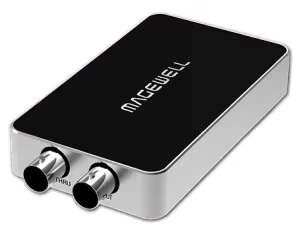
SDI sources: the USB Capture SDI range or the Pro Capture SDI range.
Both types: the USB Capture AIO (USB 3.0) or the Pro Capture AIO (PCIe). Each has an SDI input and accepts HDMI through a supplied breakout cable, and captures one input at a time.
No marketing noise. Just new product launches, firmware updates, and the occasional guide.
No spam. Unsubscribe any time. Your email is never shared.
Use SDI when the cable run is long, when you are working with broadcast equipment where SDI is the standard, or when you need a locking connector. HDMI is simpler and more common on consumer and prosumer equipment.
Yes. HDMI 2.0 and 12G-SDI can both carry 4K video at 60 fps, and both carry it uncompressed. The choice is about connector type, cable distance and compatibility with your equipment.
Yes. Magewell offers HDMI and SDI models across the USB Capture, Pro Capture and Pro Convert ranges. The USB Capture AIO and Pro Capture AIO have both HDMI and SDI inputs on one device and capture one of them at a time.
Neither is universally better. HDMI is standard for consumer and prosumer equipment. SDI is the broadcast standard for professional cameras and production infrastructure. Choose the interface that matches your source equipment.
Passive HDMI cables are intended for short runs of a few metres, and longer runs need active or fibre-optic cables. HD-SDI runs 100 metres or more on good 75-ohm coaxial cable, and SD further still; 6G and 12G-SDI travel less far. For a long run, SDI is usually the better choice.
Yes. With the Magewell Pro Convert range you can encode HDMI to NDI and decode NDI to SDI elsewhere on the network, which converts the signal and covers the distance at once. The Pro Convert for NDI to SDI outputs up to 1080p60 over 3G-SDI. Simple HDMI-to-SDI converter boxes are also available from other manufacturers.
Yes. 3G-SDI carries up to 1080p60, 6G-SDI carries 4K at up to 30 fps and 12G-SDI carries 4K at up to 60 fps. Magewell offers Pro Capture and Eco Capture cards with 12G-SDI inputs, the USB Capture SDI 4K Pro, and the Pro Convert 12G SDI 4K Plus encoder.
Enjoying your visit? Quick rating of your browsing experience so far:
Anything specific? (optional)